Thursday, 4 April 2013

Model: Fisher-Price record player

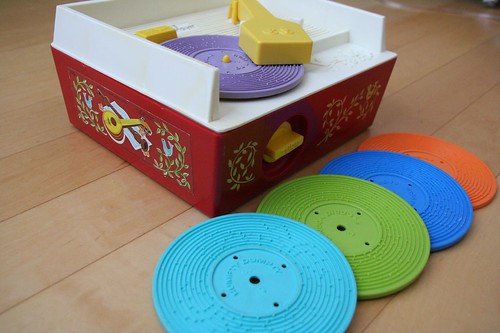
The Fisher-Price Music Box Record Player is a plastic toy first produced in 1971.  Powered by wind-up clockwork, it mimics the operation of vinyl record players using special plastic discs.

The toy was finally discontinued in the early 1990s. 

Essentially a music box, the interchangeable discs have small notches which trigger one of a number of small 'needles' in the playing arm.  Each disc plays a different nursery rhyme or popular song, such as Humpty Dumpy, Twinkle Twinkle Little Star or Camptown Races.


If this sounds familiar it's because I posted last month about a man who had developed his own system for 3D printing plastic discs for the player.

3D model: disc


This was one of the models produced for Phase 2 of my game project, so my plan was to create a basic model which looked enough like the real thing to trigger memories, but I wasn't too bothered with accuracy or detail, or optimising the model.

I intended the plastic disc to work in a standalone capacity (i.e. loose obstacles on the floor) so I started with this.

After creating a low-poly mesh as my main model, I subdivided and extruded faces to create a high-poly version of the disc with raised rings; after adding small notches I baked this (within Maya) to the low-poly model to create a basic normal map for the disc.


This turned out badly, so I ended up colouring the raised edges and creating a manual normal map by fiddling with embossing and colour channels on Photoshop.  This didn't quite emphasise the rings enough, so I added a subtle diffuse map to add detail when combined with the normal map.


 With a bit of simple lighting, the final disc looks fair enough.


3D Model: record player


The main part of the record player was fairly straightforward.  The yellow plastic playing arm and knobs were added as separate components so they can be manipulated by the game engine to simulate the actions of the toy.


The disc was then added, plus a diffuse map texture to make it look a little more like the real deal.


Finally, a very simple normal map (again, created manually on Photoshop) to add ridges to the inside rear section.


Not bad for 600 triangles.  I could probably bring this down with a bit of extra work but it's OK for a basic model for Phase 2 of my project.  I may re-visit it in more detail at some point in the future.

Model: pocket fan

Hand-held fans are powered by battery and designed to slip into a pocket.


Model


I decided to create a very plain pocket fan -- as opposed to the curved version above -- just to get it into the Phase 2 prototype game level as quickly as possible.  The model below should have taken only a few minutes to create, but I was held up triangulating the blades to ensure that they looked right.


Final stage was to UV map the surface and create a matching colour map for the model.


Nothing special but it does the job.  The blades & rotor head are a separate object so they can be rotated by the game engine.  Rather than exporting a manually-animated model I'm going to control the rotor animation from within the engine, to allow the speed to vary.


For such a simple shape it's a relatively high poly count (around 300 triangles) but I was more interested in getting it made quickly than keeping the count low.

Project Update

Blimey -- it's been a long time since I managed to post something on this blog.

March was full of illness (including the dreaded norovirus), Ofsted inspections (did very well, just in case you're wondering), and paid work thwarting progress on my MA work.

I'd also got myself in a twist creating detailed blog entries that got bigger-and-bigger, and never got posted because they weren't quite finished.  So I've decided to junk those and cannibalise them to create new, small posts based around:
  • MA project -- design & constructions notes from the 'Eggles' game I've been working on.  (I really need to find a better title than 'Eggles'.)
  • Models -- info on the models I've been creating for the 'Eggles' game.
  • Miscellaneous -- anything which takes my fancy, so long as it's related to Games Design or nostalgia.

Sunday, 10 March 2013

Phase 2: Work in Progress

I'm behind with the blog at the moment, with delays caused by paid employment and illness.  There are a number of posts I have half-written, and I'll post them (backdated) in coming days.


Partial, rough level


The video below shows a partial level that I made last week.  I'm still finishing it off, but you can see the basic idea of how it works.


The important thing to note is that what you see here is not an animation, and events are not timed in any way.  It shows the game engine responding properly to events and triggers, and collisions between objects.

At the moment I'm focusing on the player controlling the game by clicking on certain objects and adjusting a setting for them, which will alter whether the contraption works or not.
  • Fan.  When the level starts, this switches on and takes a few seconds to get up to full speed, whereupon it blows the Eggle off the platform.
  • Under the record sleeve is a balloon.  This can be inflated or deflated to adjust the angle of the sleeve, changing the slope.
  • An Eggle falls onto the turntable and is forcibly ejected at an angle, depending on the turntable's speed setting.  (Eventually, this will be an imitation Fisher Price record player but I haven't built a 3D model of that yet.) 
  • The ejected Eggle knocks a hammer over, which falls onto the control panel of the Space Truk.  The player will need to program the truck to follow a specific route to hit the next trigger.
The basic idea is working well, and the problems with physics are starting to get ironed out.  I'm still having a nightmare with friction, but you can read more about that when I've published my missing posts.


3D Printing & Nostalgia

Back in October 2012 I posted about 3D printing, looking at potential applications within video gaming.

After doing a test 3D printing project myself, I got to see the impressive Rapid Prototyping facilities in UCLan's Art & Design department workshops, including examples of CNC foam-cutting, traditional stereolithography and cutting-edge granular colour printing.  Very impressive.

Since then I've kept a casual interest in the subject.  Today, while doing research for my game project, I came across a novel use of this technology...


Led Zeppelin on the Fisher Price record player

Back in the 1970s, Fisher Price produced a toy record player which used plastic discs to play nursery rhymes.  The discs had small notches which triggered note chimes as they passed across a collection of levers housed in the needle arm.  Essentially, it was a music box with interchangeable tunes.


British engineer Murphy had been experimenting with re-creating these discs using a CNC milling machine (computer-driven cutting tool).


A video of Fred's disc for Stairway to Heaven.
(If you're wondering why it sounds funny, it's because the record player does G# scale only)

He has updated the process to create software for making discs quickly and easily using a method based on 3D extrusion printing.

This is certainly a very creative application of 3D printing, and demonstrates a way to breathe new life into nostalgic items.  Fred Murphy, I salute you!