Thursday, 31 January 2013

Pinball Piano

As regular readers will know, I'm currently developing a pianola-themed game.

While researching the topic, I came across a sound installation created by audio artist Lucas Abela.  He is certainly quite inventive: there is a quite mad clip of him playing a sheet of glass with his mouth on YouTube, which has to be seen to be believed.

Anyway, Abela has created a piano-based pinball table.


The work goes under the title "Pinball Pianola" but does not actually involve a pianola.  Instead, he appears to have used the word to imply mechanisation, and to evoke the "stuff going on" meaning associated with the suffix '-ola' (like payola or crapola).


Abela states:
I’ve devised a Frankenstein experiment, combining the greatest musical invention of all time, the Piano; with the coolest amusement machines ever conceived; Pinball, to create an interactive sound installation like no other;

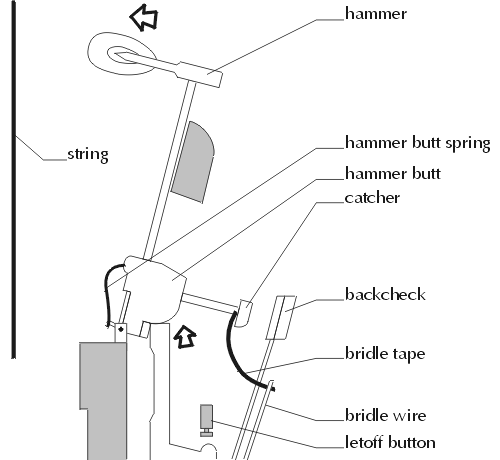
‘Pinball Pianola’, a musical device constructed by replacing the keyboard, hammers and front paneling of an upright piano, with a pinball cabinet butted up perpendicular against its exposed strings. Embracing high and low culture this instrument allows virtuosos and wizards alike to pit their skills in a game where musical compositions are created as metallic balls jettisoned into the game clash with the pianos resonating wires.

This experiment the first of in a series of individually crafted instruments [...] that introduce musical elements into the iconic game of pinball, making sound generation – not scoring – the games’ main objective.
This inventive use of a piano as both game and adapted musical instrument is technically impressive and also exciting as a concept in relation to my project work.  Pinball is an angle I hadn't considered, and the use of strings as stationary targets and piano keys as flipper controllers is inspired.

From a gaming perspective I'm sure there is potential to use hammers as kickers, and a host of other ideas too, based on this theme.  Given the wide range of themes for pinball games, I'm surprised that further research has failed to find any other pinball games based around a music instrument theme.

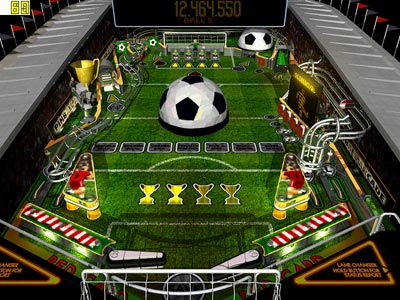
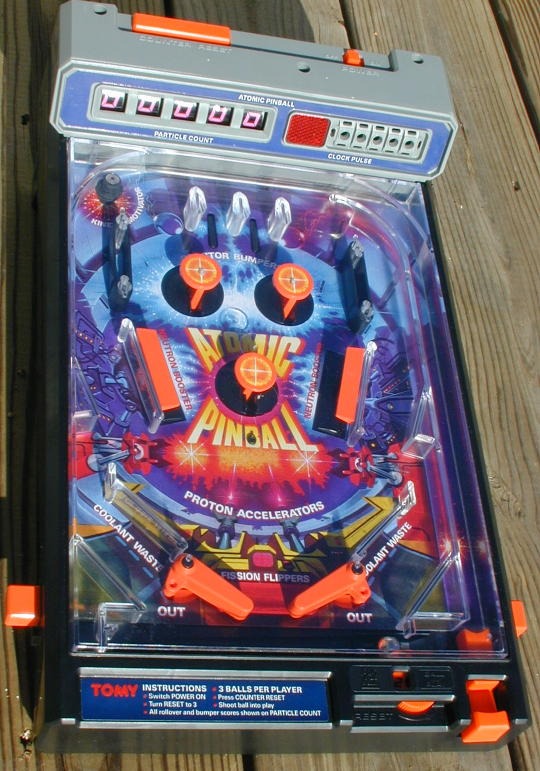
Whether physical of virtual, there are plenty of novelty pinball games, ranging from football (where presumably the ball looks like a football) to a K'nex-constructed roller coaster.

The great thing about pinball as a basis for a game is that it's readily understood.  For some people a pinball table it may act as a nostalgia trigger, but their long-established nature means that they lack the strong "I haven't seen that in years!" affect which I'm aiming for.

With regards to my own game, the idea of mixing pinball-style physics into the equation is certainly an interesting one.

Rather than mimic Abela, I'd prefer to keep the automated playing of the programmed music reel, perhaps creating a wall of piano keys which move, affecting the movement of the ball.


This concept has the strong advantage of mixing familiar elements together.  Certainly something to think about as I develop my potential ideas for a game.
Wednesday, 30 January 2013

Gaudi vs. London Underground

Following on from my recent botched attempt to moan about architecture, I found myself watching two very interesting TV programmes about the subject.  Reflection on these led me into areas which emphasised the importance of a cross-disciplinary and open-minded approach within design.

Gaudi

The Sky Arts documentary Gaudi's Barcelona was quite eye-opening.  As I've stated before, I've always disliked his work but respected it at the same time.


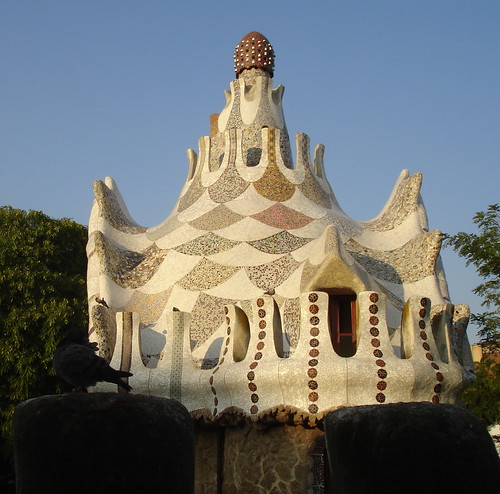
Within the programme the organic nature of Gaudi's designs shone through: emphasising irregularity, asymmetry, and natural form (trees, bones, etc.) and occasionally a "Dr Seuss" colour scheme.  Not only the buildings but also the furniture within; the windows latches; everything.  Hand-carved, unique.


This particular hand-carved, every-item-unique, styling reminded me of the seminal science fiction novel The Mote In God's Eye, which describes first contact with an alien race -- Moties -- who have evolved with an asymmetrical body.

Their fictional civilisation is extremely well-realised and carefully-thought-through, describing an approach to engineering which is similar to Gaudi's: each item they make is unique and suited to purpose.  Additionally, they have a habit of quickly dismantling, recycling and scavenging materials when constructing new objects.

(This detailed approach to xenoanthropology is similar to the work done by fellow MA Games Design student Steph Brookes, who develops new animals based on the needs for them to survive in "real life".)

The natural form of his work is also evidenced within his Neo-Gothic and Art Nouveau inspired designs like the Sagrada Familia church.  My immediate reaction when seeing this was to recall the insect-derived Geonosian architecture from Star Wars Episode II: Attack of the Clones.  I suspect that the latter takes its cues from nature, influenced by Gaudi's work.


This outer appearance belies the clever structural mechanics which support his designs.

The documentary makes clear that Gaudi's highly indulgent designs are a result of extensive sponsorship by wealthy individuals who appreciated his art.  This is, itself, interesting.  My limited knowledge indicates that ground-breaking designers & artists usually struggle with the requirement to conform to commercial necessity, and that it is only financial support like this that allows truly visionary work to thrive -- risking failure as well as success (a good example being Stanley Kubrick).

Do I like Gaudi's work any better as a result of this documentary?  No, I still dislike it.  But I am now convinced more than ever that the man was a genius.


London Underground

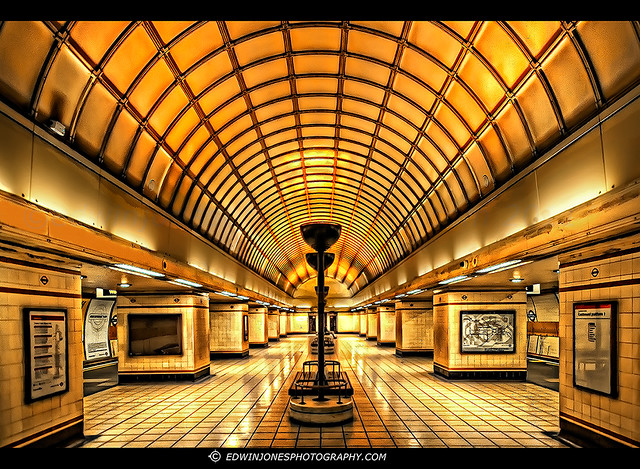
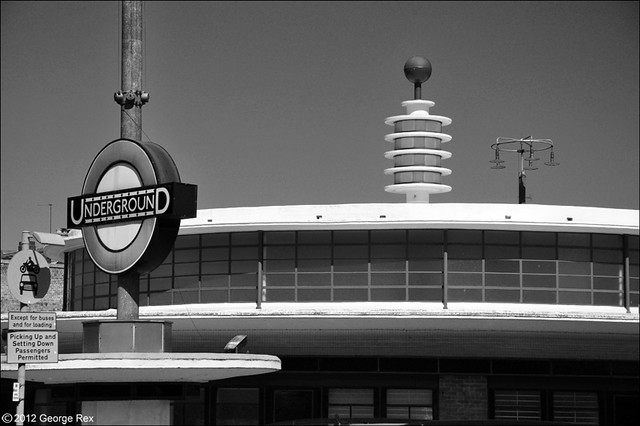
The BBC4 programme Art Deco Icons: London Transport (see clip here) examined the mass-branding of the London Underground system in the 1920s, from architecture to signage & typography.

Its Art Deco styling stands in stark contrast to Gaudi's work: everything is regular, symmetrical and formal, emphasising the Machine Age.


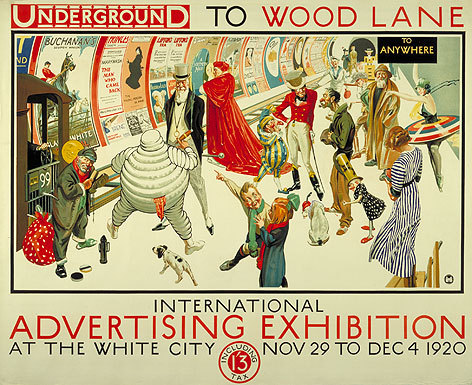
This fascinating documentary examined everything from the underlying philosophy of the branding, overseen by Frank Pick (who acted somewhat like Gaudi's sponsors in making the whole grand scheme possible), all the way through to poster design and how it reflected the change in society and work patterns.


The beauty of the sleek designs -- the inhuman Kraftwerk-like Modernism -- really appeals to me, especially because it has a warmth rather than the coldness associated with industrialisation.


The juxtaposition of these two different approaches, separated by only about 20 years and sharing some historical common ancestry in places, highlights the way that a single philosophical goal (nature-inspired form, in Gaudi's case, and machine & geometry-inspired, for the Underground) can have a dramatic effect on a series of designs.

Within the Underground programme, one piece of background music jumped out at me: Steve Reich's Piano Phase.  This minimalist piece involves two pianos playing the same sequence, slowly phasing out of sync with each other.  The effect is to create a changing pattern of rhythms, which suited the images of ant-like commuters climbing on-and-off trains.


I had come across piece this in my teens, and the phasing idea resurfaced when creating music for an experimental recording (testing a digital studio set-up) that I made in the late 1980s under the band name Airport Convenience.  Titled "Dinnertime", the voices are mostly students from Pembrokeshire -- with the exception of a heavily re-edited Richard Burton (an uncanny coincidence given my recent War of the Worlds post) and myself ("I can't take it no more").


Why post this self-indulgence on the blog?  Well, in my particular role as a game designer I've taken on the mantle of being a one-man development team, and this has led me to start working on creating my own game music. And the last time I wrote any music in a serious manner was back at the time I recorded "Dinnertime".  Funny how things come round like that. 


Saturday, 26 January 2013

Design Process

The British Design Council have a model which describes the design process.  This has come up in conversations a number of times recently, so I thought it was worth describing it here because it's pertinent to the MA.

The first thing to remember is that this kind of model represents an analysis rather than a rule.  It has been formed by examining a number of prominent companies (in this case, they picked firms like Lego, Microsoft, Sony, & Xerox) and looking for a common pattern in the way they do things.

(These analyses are interesting in themselves -- the Microsoft article explains the thinking behind Office 2007 and its infamous ribbon bar interface, and demonstrates a staggering arrogance on the part of their designers, aiming for a simpler interface by removing (useful) advanced features rather than just hiding them.)

The design process model is known as the 'double diamond'.  The image below is my own adaptation of their diagram, showing the role of the brief more clearly.


Although it's not stated on the diagram, the whole process usually starts with a problem that needs to be solved.

The first phase -- Discovery -- deals with research & brainstorming, including market research and an analysis of user needs.  As this stage progresses, the number of options available will expand rapidly, driven from the initial brief.

The second phase -- Definition -- begins with a feasibility review, which will start to filter & discard ideas which cannot be carried forward.  This may come down to cost or materials, or time.  Anything which deviates from the brief will probably need to go, too.  This may include pitching & prototypes, and concludes with a small number of ideas to be offered as a solution to the problem specified in the brief.

Development takes an approved & signed-off idea and starts to go into details.  This may lead to a number of prototypes or demo versions, which will need to be tested & reviewed.

Finally, the product is delivered.  At this stage it is necessary to reduce options, and select the version which will be delivered to the client or customer.  Additionally, this will often require the setting up of a feedback system to help evaluate the effectiveness of the solution in its real-world use.

This is not the only model to describe a design process, but it dovetails nicely into the spiral model (previously posted here) which describes the rapid application development iterative design process, common in computer programming.


Here, the whole double-diamond process will be repeated -- in differing levels of detail -- in each full rotation around the centre.

These models are useful, because they present a framework when planning a project, and highlight the importance of milestones (e.g. feasibility review) on.

Friday, 25 January 2013

Patterns in Game Design (part 1)

The book Patterns in Games Design, by Staffan Björk & Jussi Holopainen, examines frameworks for analysing games.  More specifically, they offer models for creating games, based on those analyses.

In this series of posts I'll be looking at their ideas.

Activity-based framework

This model begins by splitting the game into states, and grouping these under four categories:


Holistic items relate to the whole game, and how it is initialised and played.  This is divided into game instance (the context), game session (each player's journey through the game), play session (each turn, or section such as a level) and extra-game activities (such as high-score tables or customising the game appearance).

Boundary items specify game mechanics: rules, modes of play and goals.  Goals are vital in any game, as they introduce structure.  Modes of play are best illustrated by Pac-Man, where the player is chased by ghosts for much of the time; however, at certain points the play switches mode and the player chases the ghosts.

Temporal components relate to the flow of the game.  This encompasses actions (active decisions by the player), events (automated responses to decisions), closures (changes of game state), end conditions (such as all players finishing), and evaluation functions (algorithms which calculate when closures or end conditions should be triggered).

Finally, structural components are about the people and technology: facilitator (e.g. banker in Monopoly), players, elements (board, pieces, weapons, environment), interface (control & feedback) and game time. This last one is not always needed.

This is an interesting analysis, but I don't know how useful it is.  As mentioned above, the authors use Pac-Man as their example. However, I suspect that it is better suited to board games.

Pianola game concepts (part 2)

Over the last couple of weeks I've been working on ideas for a game inspired by the pianola (also known as a player piano or self-playing piano).

The previous post introduced two concepts which had fallen out of my brainstorming process: graphical sequencing and programming-based games.  This post considers another couple of items...

Interaction with the piano

As a machine, a piano shows great potential as a sandbox for play.  Indeed, the pianola has even greater potential due to the sheer number of moving parts (adding bellows and drums).


My first exposure to this idea came from the Tom & Jerry cartoon "The Cat Concerto", created by Fred Quimby & Hanna/Barbera in 1946, in which the two characters interact with piano keys, hammers, strings and piano lid whilst Tom attempts to play a piece by Liszt.  (The intricate and carefully-synchronised animation is still seen as a masterwork 67 years later, and few modern animators would attempt it without the aid of 3D CG models.)


(By "sheer coincidence" (a subject of legal debate), Warner Bros also released a similar Looney Tunes cartoon with Bugs Bunny the same year.  The legacy of both was referenced in Who Framed Roger Rabbit during the 'Donald Duck vs. Donald Duck' piano sequence.)

The idea of interacting with moving piano keys (and the rest of the mechanism) was also explored in the music video for Fatboy Slim's "Demons", featuring guest vocalist Macy Gray.  This gets a little abstract, but shows how the idea does not need to be limited by physical characteristics.


This particular video led me to consider the way in which a piano keyboard could turn into a platform game of some kind, controlled by the music roll.  This is a strong contender for the final game idea, and shows great flexibility and promise.

Traversal games

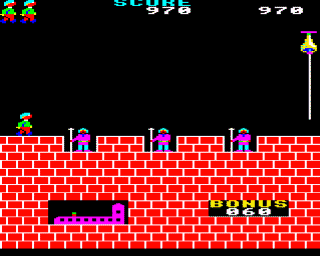
We take platform games for granted nowadays, but the groundwork for side-scrollers like Super Mario were laid a long time ago by things like Jungle Hunt and Hunchback.


In these games the player must traverse an assault course.  The idea comes full circle with the Japanese TV show Takeshi's Castle, which features an assault course based on platform games!


One genre of traversal game which proves popular with my teenaged students are those based on motorcycle trials games, based around moto-cross motorbikes or BMX bicycles.  These require the player to guide a motorbike over obstacles and often require a combination of balance (controlled by adjusting the rider's position) and speed.


Throwing in a nostalgia trigger, blog readers aged over 40 will remember the BBC TV shows "Kick Start" & "Junior Kick Start" presented by Peter Purves...


One of my possible ideas for a pianola-based game involves the player traversing a piano keyboard as a tune plays.  The player could face a series of obstacles, and be lifted (or thrown) into the air by keys as they move up-and down, and there would be an element of timing based on reading the notes in advance on the piano roll.


An alternative idea involves the player pre-programming the roll, to force an object along an assault course.  The disadvantage to this alternative idea is that the tune produced would be horrible!

Of course, these ideas are just the first to leap out from initial brainstorming.  There may be a number of other potential mechanics to explore, but these certainly start the ball rolling.