The book Patterns in Games Design, by Staffan Björk & Jussi Holopainen, examines frameworks for analysing games. More specifically, they offer models for creating games, based on those analyses.
In this series of posts I'll be looking at their ideas.
Activity-based framework
This model begins by splitting the game into states, and grouping these under four categories:
Holistic items relate to the whole game, and how it is initialised and played. This is divided into game instance (the context), game session (each player's journey through the game), play session (each turn, or section such as a level) and extra-game activities (such as high-score tables or customising the game appearance).
Boundary items specify game mechanics: rules, modes of play and goals. Goals are vital in any game, as they introduce structure. Modes of play are best illustrated by Pac-Man, where the player is chased by ghosts for much of the time; however, at certain points the play switches mode and the player chases the ghosts.
Temporal components relate to the flow of the game. This encompasses actions (active decisions by the player), events (automated responses to decisions), closures (changes of game state), end conditions (such as all players finishing), and evaluation functions (algorithms which calculate when closures or end conditions should be triggered).
Finally, structural components are about the people and technology: facilitator (e.g. banker in Monopoly), players, elements (board, pieces, weapons, environment), interface (control & feedback) and game time. This last one is not always needed.
This is an interesting analysis, but I don't know how useful it is. As mentioned above, the authors use Pac-Man as their example. However, I suspect that it is better suited to board games.
Over the last couple of weeks I've been working on ideas for a game inspired by the pianola(also known as a player piano or self-playing piano).
The previous post introduced two concepts which had fallen out of my brainstorming process: graphical sequencing and programming-based games. This post considers another couple of items...
Interaction with the piano
As a machine, a piano shows great potential as a sandbox for play. Indeed, the pianola has even greater potential due to the sheer number of moving parts (adding bellows and drums).
My first exposure to this idea came from the Tom & Jerry cartoon "The Cat Concerto", created by Fred Quimby & Hanna/Barbera in 1946, in which the two characters interact with piano keys, hammers, strings and piano lid whilst Tom attempts to play a piece by Liszt. (The intricate and carefully-synchronised animation is still seen as a masterwork 67 years later, and few modern animators would attempt it without the aid of 3D CG models.)
(By "sheer coincidence" (a subject of legal debate), Warner Bros also released a similar Looney Tunes cartoon with Bugs Bunny the same year. The legacy of both was referenced in Who Framed Roger Rabbit during the 'Donald Duck vs. Donald Duck' piano sequence.)
The idea of interacting with moving piano keys (and the rest of the mechanism) was also explored in the music video for Fatboy Slim's "Demons", featuring guest vocalist Macy Gray. This gets a little abstract, but shows how the idea does not need to be limited by physical characteristics.
This particular video led me to consider the way in which a piano keyboard could turn into a platform game of some kind, controlled by the music roll. This is a strong contender for the final game idea, and shows great flexibility and promise.
Traversal games
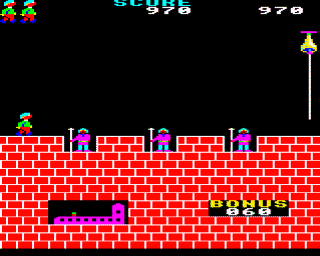
We take platform games for granted nowadays, but the groundwork for side-scrollers like Super Mario were laid a long time ago by things like Jungle Hunt and Hunchback.
In these games the player must traverse an assault course. The idea comes full circle with the Japanese TV show Takeshi's Castle, which features an assault course based on platform games!
One genre of traversal game which proves popular with my teenaged students are those based on motorcycle trials games, based around moto-cross motorbikes or BMX bicycles. These require the player to guide a motorbike over obstacles and often require a combination of balance (controlled by adjusting the rider's position) and speed.
Throwing in a nostalgia trigger, blog readers aged over 40 will remember the BBC TV shows "Kick Start" & "Junior Kick Start" presented by Peter Purves...
One of my possible ideas for a pianola-based game involves the player traversing a piano keyboard as a tune plays. The player could face a series of obstacles, and be lifted (or thrown) into the air by keys as they move up-and down, and there would be an element of timing based on reading the notes in advance on the piano roll.
An alternative idea involves the player pre-programming the roll, to force an object along an assault course. The disadvantage to this alternative idea is that the tune produced would be horrible!
Of course, these ideas are just the first to leap out from initial brainstorming. There may be a number of other potential mechanics to explore, but these certainly start the ball rolling.
Over the last couple of weeks I've been working on ideas for a game inspired by the pianola(also known as a player piano or self-playing piano).
Brainstorming
The normal process of brainstorming involves throwing everything (including the kitchen sink) at the wall and seeing what sticks. However, in this case, I've found that some concepts have really caught my attention at an early stage -- as a result, this mind map represents a summary of the brainstorming process:
If you enlarge the picture you'll see that most concepts have been split between "piano keys" and the other on the notion of "programmable machines".
So which concepts jumped out at me? Let's examine the first couple:
Graphical sequencing
Firstly, there's the connection between the graphical sequencing found on punched cards and that found in singing & dance games. I've already mentioned this in a previous post, but it's worth re-iterating it here.
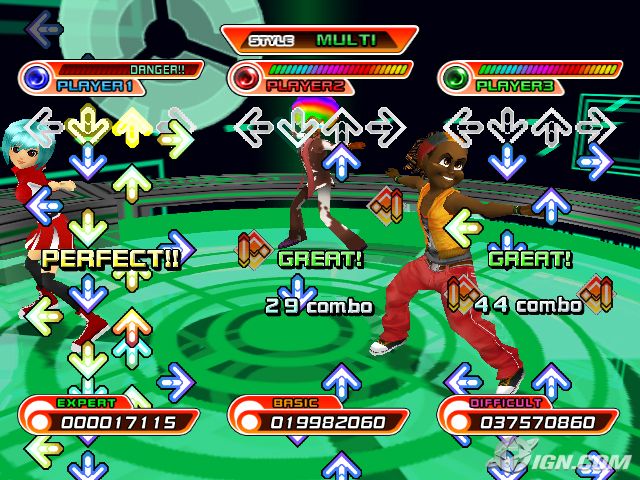
Most of these games require players to follow an on-screen sequence as it is revealed -- usually, this sequence scrolls (just like the paper in a pianola): vertically for dance games, horizontally for music games (usually mimicking the notes on a musical score).
Programming-based games
Secondly, there's the programming element: creating a sequence of instructions which will be executed, in order. There are two approaches to this within existing video games.
The first method uses pre-programmed trial-and-error puzzle games. The player creates a 'program' and then executes it, watching the results. If the program fails to work, the player amends their program and tries again. Examples of this include:
Cow Maze -- a popular online Flash game, written in German and never really translated for a mass market. (Not sure why, because it's a lot of fun). Place arrows on the map and set the cow walking. However, there are a limited number of arrows, and they only point in certain directions.
Light-Bot -- this online Flash game requires players to create a sequence of instructions (using the commands forward, left, right, jump, etc.) which is then executed to move the robot around objects to a final goal. This also, cleverly, allows players to create re-usable subroutines, where new commands can be created, based on a small sequence of existing commands. It's so good I actually use it when teaching programming to students -- it does a fantastic job of preparing them to think like machines, breaking tasks into steps, and also shows that it can be fun.
Professor Layton train mini-games -- the Professor Layton series of games for the Nintendo DS are extremely popular (13 million sold), and this mini-game requires players to click points on a grid map to lay a train track. The train must pass through waypoints to reach a final goal, but must do it within a maximum number of steps. Once the track is laid (in 2D, from above), the game shows a cute isometric projection of the train's progress as it follows the track. An added challenge is that the length of the train increases in later levels, bringing the problem of it crashing into its own carriages.
The second method uses live, interactive programming. In these games, the player must lay out a sequence of instructions under time pressure, often after the execution has started.
Pipe Mania -- this game was published 23 years ago by LucasArts. In it, the player must drop sections of shaped pipe into a grid, providing a path for slow-flowing 'ooze'. Players must also navigate the pipe around obstacles and through waypoints, but are hampered by the selection of shapes on offer. A number of clones of this game have been produced over the years, for a variety of platforms including modern 7th generation consoles and set-top boxes.
You can see that programming, as a concept, has great potential within games.
We'll continue looking at the concepts which "jumped out" in the next blog. See you soon!
My friend Jes has been a superstar! Why? Because she has introduced me to the Land of Lost Content!
This museum is based in Craven Arms, Shropshire, and claims to be the largest archive of 20th Century popular culture in the world. Wow! This appears to be a treasure chest of nostalgic items.
This is likely to prove an invaluable resource for my research, mainly because it will provide a number of triggers for development of game ideas (just like the pianola did) and may also provide visual content for "trawled" nostalgia games (such as my yet-to-be-developed "I Love The '80s" game concept, or point-and-click hunt-the-object casual games).
Fashion designer Wayne Hemingway has become involved with the collection, creating a digital archive of the content. At present this is available only to "students and academics from subscribing institutions" so I'll need to investigate further.
With half of Britain covered in snow, I'm unable to visit this fascinating attraction but will update the blog with more information when the opportunity allows.
Some months back I mentioned the notion of coin drop. The term refers to arcade games, where a player is offered the chance to continue their game ... so long as they insert a coin within 10 seconds. Essentially, it's a compliance-based pressure sales tactic.
TV masterpiece The Wire introduced me to the notion that American newspaper journalism can be pretty good stuff, and I started reading some of the quality US newspapers online. Despite being highly parochial, I've found them to be a very interesting source of information.
A recent article in The New York Times, entitled "I'm losing money. Why do I feel so good?", examined the psychology of gambling addiction and the ways in which casinos are using modern digital technology to manipulate players.
One major trick is to make players think that they've almost won. This is far easier with digital devices, because the designer can cheat by forcing events rather than waiting for them to occur randomly. For example, on a mechanical fruit machine the odds of getting three-in-a-row depend on the frequency of symbols on each reel. With a digital display, the symbols can be picked using an algorithm to ensure the appearance of an "almost won" state.
Of course, the key to this is to make the player forget that the machine is in charge. By simulating the appearance & rotation of traditional mechanical reels, and ensuring that "almost won" does not occur so often as to appear suspicious, the designer can ensure a more stimulating playing experience.
Manipulation of tension is nothing new. TV quizzes like The Chase build tension by adjusting the speed of delivery and difficulty of questions to ensure as close a finish as possible. Hollywood movies are constructed to make sure that the hero or heroine saves the day at the last possible second, snatching victory from the jaws of defeat.
From a game design perspective the "I want another go" reflex is vitally important. This comes back to the idea of flow, where the challenge and skills levels must be carefully paced to keep a player's interest.
One of my favourite examples of good flow is Tetris. The player undergoes a crisis when blocks fall badly, and must use skill to work their way out of the situation. The elation felt at only just "rescuing" the current game is addictive.
The player craves challenge, sometimes deliberately playing risky moves for the satisfaction of killing three or four rows of blocks at once. A skilled designer could include a secret mechanic which recognises such play and deliberately lowers the probability of long bricks until the block structure has risen high, to heighten the tension.
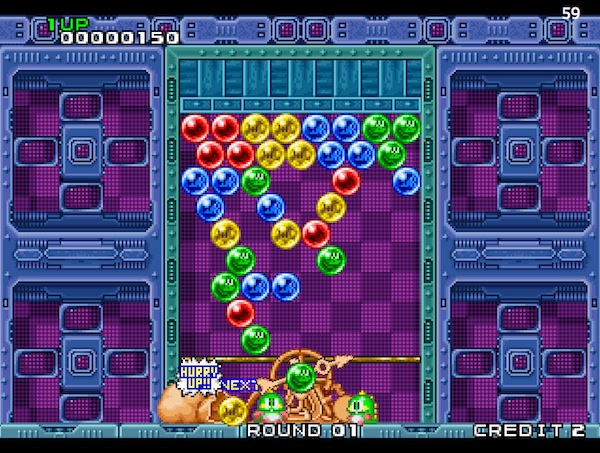
The game Puzzle Bobble, also known as Bust-a-Move or (its clone) Beehive Bedlam, follows an almost identical approach to tension, despite having a different core mechanic. This, too, can be artificially manipulated by adjusting probability to heighten the effect.
There are a number of ways to encourage a player to play again, and both carrots & sticks can be used. Coin drop uses a negative stimulus ("don't throw all that hard work away"); digital slot machines & games like Tetris use a positive one ("you almost did it that time!"). Either way the result is the same, which is to subtly manipulate the player into playing just one more time.